
For Armenians, Echmiadzin is more than a town. It is the spiritual heart of the country and the center of the Armenian Apostolic Church. People often compare it to the Vatican, because this is where the Catholicos of All Armenians, the church’s highest authority, has his seat.
It sits just outside Yerevan and holds some of the oldest Christian churches in the world. Together with the ruins of Zvartnots, the cathedral and churches form a UNESCO World Heritage Site, and the town makes one of the easiest, most rewarding day trips from the capital.
This guide covers what to see, how to get there from Yerevan, dress code and etiquette, costs to check on the day, and a simple one-day plan. For booking rhythm, buffer days, and the packing habits that make day trips less messy, start with my flashpacker travel logistics hub.
At a glance
| Item | Details |
|---|---|
| Official town name | Vagharshapat (Echmiadzin, Etchmiadzin, and Ejmiatsin all appear on signs and maps) |
| Distance from Yerevan | About 20 km west of the city center |
| Travel time | Roughly 30 to 45 minutes by car or minibus, traffic depending |
| Main sights | Mother Cathedral, Treasury museum, St. Hripsime, St. Gayane, St. Shoghakat, Zvartnots ruins |
| Time needed | Half a day for the highlights, a full day with Zvartnots and the museums |
| Dress code | Shoulders and knees covered; scarf for women appreciated |
| Best moment | Sunday morning liturgy, if you are happy with crowds |
Where is Echmiadzin?
Echmiadzin’s official name is Vagharshapat, and it lies about 20 km west of central Yerevan in Armavir Province. If your app says Vagharshapat and your guidebook says Etchmiadzin, relax. Same place.
Most visitors pair it with Zvartnots Cathedral, right beside the main road between the two.
A brief history
Armenia was the first country to adopt Christianity as a state religion, traditionally dated to 301 AD. According to tradition, St. Gregory the Illuminator had a vision of Christ descending from heaven and striking the ground with a golden hammer to show where the first church should stand. The name Echmiadzin is usually translated as “the descent of the Only Begotten.”
The first cathedral was founded here in the early 4th century, around 301 to 303 AD. The building you see today was largely rebuilt in the 480s, then added to over the centuries, including a bell tower in the 17th century. Through all of that, Echmiadzin grew into the center of the Armenian Church, and it remains so today.
What to see in Echmiadzin
Mother Cathedral of Holy Echmiadzin
The highlight of any visit is the Mother Cathedral, often called the oldest cathedral in the world. Its foundation dates to the early 4th century, though the current stone structure reflects many rebuilds and additions.
- Architecture: A cross-shaped plan with a central dome, early Armenian bones, and later decorative layers inside.
- Recent restoration: A long restoration program began in 2012. The cathedral was reconsecrated and reopened to visitors on September 29, 2024, so older reviews describing scaffolding and a closed interior may be out of date.
- Spiritual role: This is the seat of the Catholicos, so you are walking into a working center of the church, not a museum.
Treasury and museums
The Mother See runs its own museums inside the complex. The main one is the Alex and Marie Manoogian Treasury House, and it is where the famous relics are kept.
- Highlights: The Holy Lance of Geghard (the spear said to have pierced Christ’s side), a relic said to come from Noah’s Ark, cross reliquaries, and the reliquary hands of the apostles Thaddeus and Bartholomew.
- Also on site: The smaller Ruben Sevak Museum and the Khrimian Museum.
- Hours: The official Mother See site lists the museums as open Tuesday to Sunday, 10:30 to 17:30. That means Monday is a poor day if the relics are your reason for going.
My honest take: give the Treasury at least 45 minutes. The relics are the headline, but the manuscripts and church silver are what make the place click.
St. Hripsime Church
Built in 618 AD, St. Hripsime is one of the finest examples of early Armenian church architecture. It honors Hripsime, a young Christian woman who, according to tradition, fled Rome with her companions and was martyred in Armenia. Its compact stone mass and cross-in-square design influenced Armenian church building for centuries.
St. Gayane Church
Dating from 630 AD, St. Gayane is named for the abbess who led Hripsime’s group and was martyred alongside them. Its calm, simple lines make it one of the most photographed churches in Armenia.
St. Shoghakat Church
Built in 1694, Shoghakat stands where some of Hripsime’s companions are said to have been martyred. The name means “drop of light,” after a vision of divine light said to have fallen here. It is the youngest of the group and small, so it pairs naturally with St. Gayane on foot or by quick taxi.
Zvartnots Cathedral (on the way)
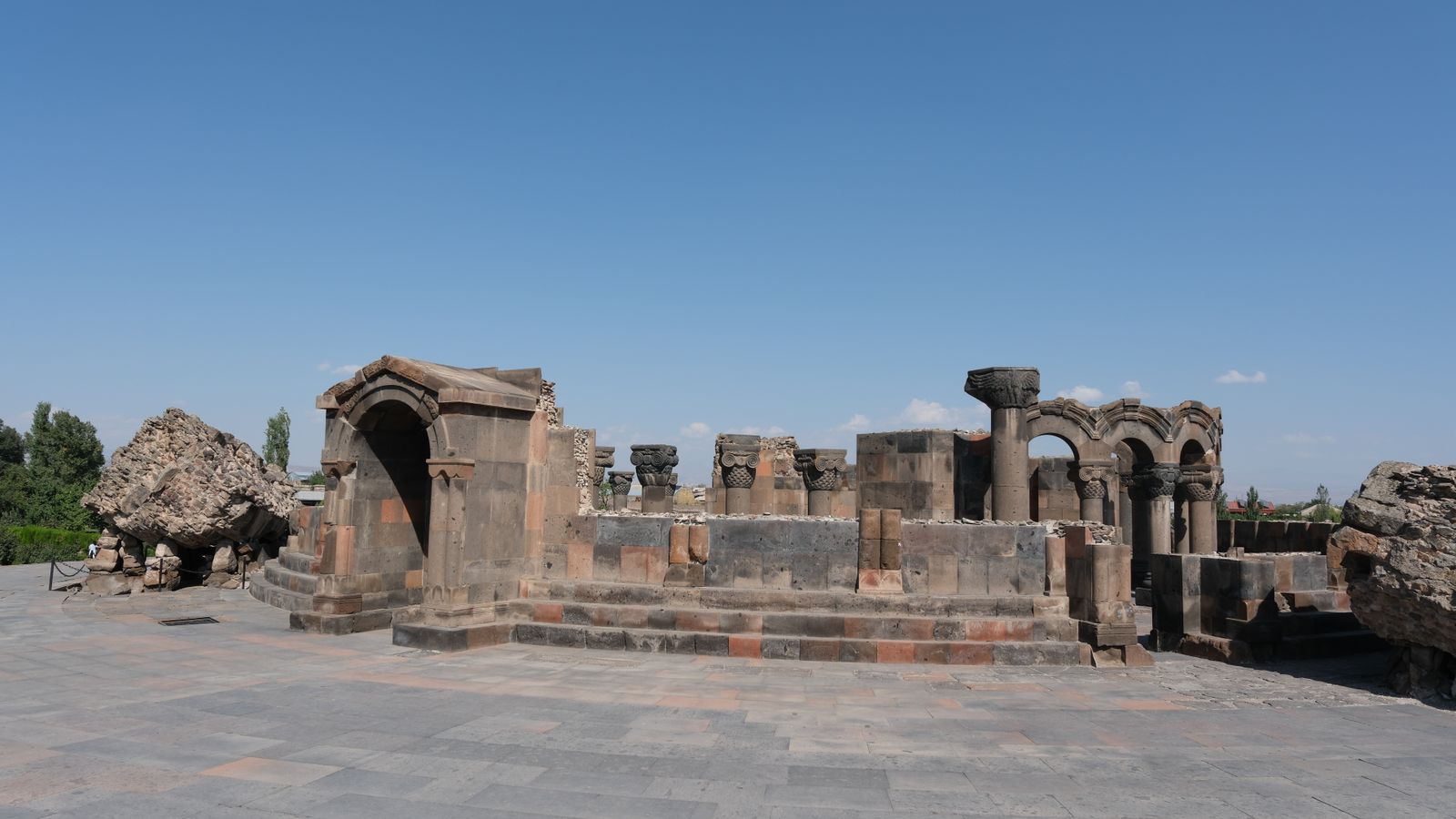
Zvartnots is the ruin of a 7th-century round cathedral built under Catholicos Nerses III and collapsed, likely in a 10th-century earthquake. What remains is a field of columns, carved capitals, and partly restored arches, plus a small museum. On a clear day, Mount Ararat sits behind it. Budget 30 to 60 minutes.
Getting to Echmiadzin from Yerevan
- Minibus or bus: Direct services run from Yerevan’s Kilikia Central Bus Station, and the last stop is a short walk from the cathedral gate. Route numbers in recent guides include 203 (with 202 and others also cited), and published fares range from about 250 to 400 AMD. Pay the driver in small notes and confirm the number at the station.
- Taxi app: Yandex Go and GG both work in Yerevan. One-way quotes to Echmiadzin commonly land around 3,000 to 5,000 AMD, more with surge pricing. For a round trip with waiting time, agree the price before you leave.
- Private driver: The easiest way to add Zvartnots and still see all four churches without walking between them in the heat.
- Group tours: Many Yerevan operators sell half-day Echmiadzin and Zvartnots trips, and some extend to Khor Virap for the Ararat view.
The churches are spread across town, so decide in advance whether you are walking or riding between stops.
Costs (verify on the day)
Prices move, and church museums change their boards without much notice. Treat these as planning bands, then confirm at the ticket window.
| Item | Planning band (foreign visitors) | Notes |
|---|---|---|
| Mother Cathedral and churches | Free | Donations and candle purchases welcome |
| Manoogian Treasury House | 2,000 AMD | Official Mother See price list; closed Mondays |
| Ruben Sevak Museum | 500 AMD | Same hours as the Treasury |
| Zvartnots site and museum | 1,500 AMD adult | Hours vary by listing; check before a Monday visit |
| Minibus from Kilikia | About 250 to 400 AMD each way | Cash to the driver |
| Taxi app, one way | About 3,000 to 5,000 AMD | Surge pricing can push it higher |
| Guided half-day tour | Wide range | Ask what entry fees are included |
Verify on the day: museum hours, whether a service or ceremony is limiting interior access, and whether your tour price includes the Treasury.
When to visit
Echmiadzin works year-round.
- Spring (April to June): Mild weather and green gardens. A comfortable season for walking between churches.
- Summer (July and August): Hot on the Ararat plain, with little shade between sites. Go early.
- Autumn (September to October): Cooler days and harvest season in the valley. My pick for comfort.
- Winter: Fewer visitors, cold days, and occasional snow.
Sunday morning brings the cathedral to life with chant, incense, and full congregations. Published start times for the main Sunday liturgy vary between about 10:00 and 11:00, so check the current schedule if you want to attend. Major feast days draw large crowds, and visitor access to the interior can be limited during big services.
Etiquette and dress code
Echmiadzin is an active religious site, and these are working churches.
- Dress modestly: Women should cover shoulders and knees; men should skip shorts.
- Headscarves: Appreciated for women and common among local worshippers, but not strictly enforced for visitors.
- Photos: Allowed in most areas, but put the camera down during services and never photograph people at prayer up close.
- Behavior: Speak quietly, do not walk between worshippers and the altar, and do not turn your back on a service to frame a shot.
A light scarf earns its bag space here. It covers your head or shoulders at the door, shades you between churches, and handles an over-chilled minibus on the way back.
Suggested one-day itinerary
Morning: Leave Yerevan early and stop at Zvartnots on the way while the light and temperature are kind.
Late morning: Mother Cathedral, the courtyard, and the Treasury House.
Lunch: A simple cafe in town, then a rest before the next round of churches.
Afternoon: St. Hripsime, then St. Gayane and St. Shoghakat.
Evening: Back to Yerevan for dinner and a stroll along Northern Avenue.
Short on time? The half-day version is the cathedral, the Treasury, and St. Hripsime.
Pros and cons
| Pros | Cons |
|---|---|
| Home of the world’s oldest cathedral foundation | Crowded on Sundays and feast days |
| Several UNESCO-listed churches in one town | Limited signage, so a guide adds context |
| Easy, cheap day trip from Yerevan | Churches are spread out, so plan transport between them |
| Living church, not just a monument | Treasury closed on Mondays |
Building a wider Caucasus trip
Echmiadzin is a church-and-history day. If your trip runs into the wider Caucasus, the strangest contrast I can point you to is my guide to the mud volcanoes of Azerbaijan, a day of cool gray mud, rock art, and gas fires outside Baku. Just know the Armenia and Azerbaijan land border is not open to ordinary travelers, so linking the two usually means flying through a third city. Check current entry rules before you plan that loop.
Bottom line
Echmiadzin is not only for pilgrims. From the newly reopened Mother Cathedral to the quiet stone of St. Gayane, it gives you a real sense of Armenia’s spiritual roots within 45 minutes of Yerevan. Go early, dress for church, check the museum days, and leave the afternoon for the churches beyond the cathedral gate.
FAQs
What is Echmiadzin famous for?
It is the spiritual center of the Armenian Apostolic Church, the seat of the Catholicos, and home to a cathedral founded in the early 4th century.
How far is Echmiadzin from Yerevan?
About 20 km, or roughly 30 to 45 minutes by car or minibus depending on traffic.
Is Echmiadzin worth visiting if I am not religious?
Yes. The churches and Zvartnots are UNESCO-listed, and the architecture and relics are fascinating on their own terms.
Is the Mother Cathedral open now?
Yes. It reopened after restoration on September 29, 2024. Access can still be limited during services and ceremonies.
Can I visit Echmiadzin in half a day?
Yes. The cathedral, Treasury, and St. Hripsime fit into a few hours. Add Zvartnots and the other churches for a full day.
