
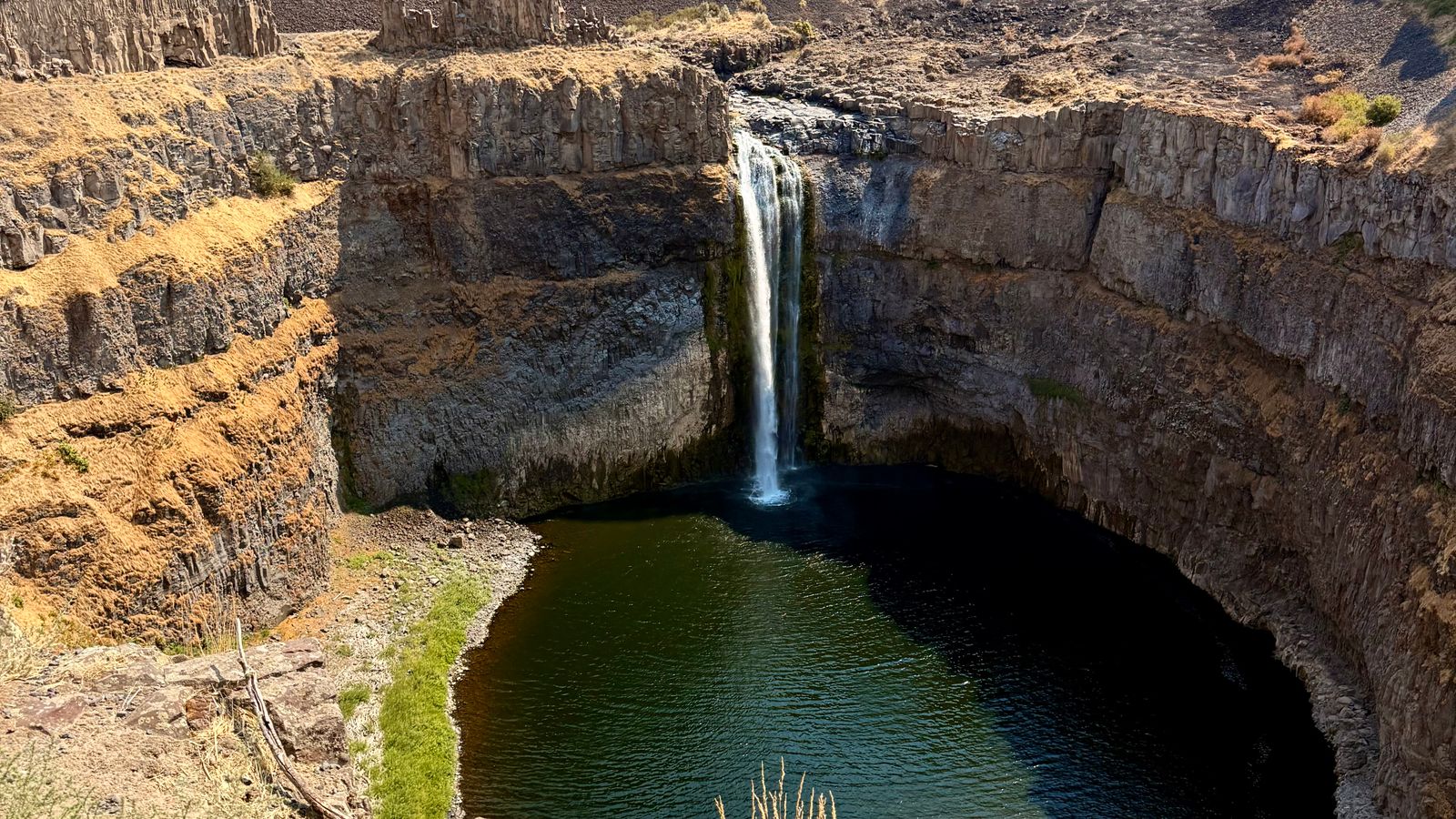
Palouse Falls is one of Washington’s most spectacular natural landmarks. The Palouse River drops about 198 feet into a basalt bowl, and the canyon around it was carved by the Ice Age floods more than 13,000 years ago. It is Washington’s official state waterfall, and with golden hills and sheer cliffs all around, it is a favorite for photographers and road trippers.
On the way there, many travelers also stop at #ThatNWBus, a graffiti-covered 1955 school bus parked on the edge of Washtucna. It is a free roadside art piece, not a place to stay, and it makes a fun 15-minute stop on the drive in.
This guide covers the best time to visit Palouse Falls, how to get there, current fees and rules, where to stay nearby, and how to fit the bus into your route. For more big-landscape trips across the West, see my Western US parks and road trips hub.
Palouse Falls at a glance
| Item | Planning note |
|---|---|
| Where | Palouse Falls State Park Heritage Site, off Highway 261 in southeastern Washington |
| Parking pass | Discover Pass: $10 for one day or $45 for a year |
| Hours | Summer 6:30 am to dusk; winter 8 am to dusk |
| Overnight | Day-use only; no camping or overnight parking |
| Best months | March to May for the strongest flow and green hills |
| Time needed | 1 to 2 hours at the park; a full day with the drive |
Where Is Palouse Falls and How Do You Get There?
The park sits in the channeled scablands of southeastern Washington, between Washtucna and Starbuck, near where the Palouse River joins the Snake River. There is no public transportation, so you need a car. Rough driving times:
- From Spokane: About 2 hours
- From the Tri-Cities (Kennewick, Pasco, Richland): About 1.5 hours
- From Seattle: About 4 to 4.5 hours, mostly on I-90
Most routes funnel through Washtucna on Highway 26 or Highway 261. From there, follow Highway 261 south to the signed turnoff for Palouse Falls Road. The last couple of miles are a narrow road that recent trail reports describe as partly gravel, with washboard sections that get slick when wet.
Parking is the real bottleneck. State Parks warns that the lot is extremely limited and that you can expect long waits to get in on weekends and holidays. RVs and trailers are not allowed.
If you are flying in from out of state, Seattle and Spokane are the usual gateways. My guide to the best time to visit Seattle helps if you are pairing the falls with a city stay.
Fees, Hours, and Park Rules
These details were checked on the Washington State Parks site in October 2026. Rules change, so confirm before you go.
- Discover Pass: Required to park. A one-day pass is $10 and an annual pass is $45 (the annual price went up from $30 in October 2025). There is a pay station on site, but buying ahead saves hassle given the lack of cell service. Washington also offers a handful of Discover Pass free days each year.
- Hours: 6:30 am to dusk in summer and 8 am to dusk in winter.
- Day-use only: The old campground is closed, and there is no overnight parking.
- Canyon trails closed: All trails into the canyon and to the base of the falls are permanently closed. After years of injuries, and some deaths, on the steep user-made paths, the park closed them for good in 2022. Stay in the designated viewing areas.
- Facilities: Restrooms, picnic tables, and a sheltered picnic area. The water system is shut off from about October 31 to April 1, so bring your own water.
- Other rules: Dogs must be on a leash. Fires are allowed only in designated grills, and summer burn bans can ban open flames entirely. Swimming is not an option here.
Cell service is spotty to nonexistent, and the park is a long way from emergency help. Download maps and your pass before you leave town. For more booking and offline-planning habits, see my flashpacker travel logistics hub.
Best Time to Visit Palouse Falls
The waterfall flows all year, but the volume and the scenery change a lot by season.
Spring (March to May)
Spring is the best time for most people. Snowmelt and spring rain push the river to its highest flow, so the falls are loud, wide, and misty. The hills around the canyon turn green, with wildflowers along the rim. Temperatures are usually mild. The catch is crowds, especially on April and May weekends, so plan for a weekday or an early start.
Spring is also tulip season in western Washington. If you want a two-sided spring road trip, pair the falls with the Skagit Valley Tulip Festival.
Summer (June to August)
Summer is hot and dry, and the flow drops steadily. By late summer the falls can be a fraction of their spring self. The hills fade to gold, which has its own appeal for photos. Afternoons often top 90°F with almost no shade, and summer heat out here does not care about your internal thermostat. Go early in the morning or near sunset, carry more water than you think you need, and check for burn bans.
Fall (September to November)
Fall brings cooler weather and thinner crowds. Flow is usually modest until rain returns later in the season, and the hills stay tan and gold. September and October are comfortable months for walking the rim. Daylight shortens, so remember the park closes at dusk.
Winter (December to February)
Winter is stark and quiet. A dusting of snow on the basalt can be beautiful, and flow can pick up after rain or thaws. Roads and paths can be icy, the water is off, and the gravel access road can be rough. Go only with a good forecast and a car you trust.
Best Times of Day for Photography
- Morning: Gates open at 6:30 am in summer. Early light is soft, and you beat the parking rush.
- Late afternoon and sunset: The canyon walls glow and the shadows add depth. This is the classic shot.
- Night: The sky out here is dark, but the park closes at dusk, so night photography inside the park is not allowed. Shoot stars elsewhere in the area, on land where you have permission.
Viewpoints and Short Walks
The park is small, about 94 acres, but it has three distinct views of the falls.
- Lower viewpoint: A few steps from the main parking and picnic area, with a direct view of the falls. There is a fully accessible viewing area with an observation shelter and historical displays.
- Interpretive path: A paved path with signs on the geology and history of the canyon.
- Fryxell Overlook: The highest viewpoint, reached from the interpretive path or the gravel secondary parking area. It gives the widest panorama of the falls and the Palouse River canyon.
Rattlesnakes live here, so watch where you step in warm weather. Yellow-bellied marmots are a common sight around the rocks. Keep well back from unfenced cliff edges.
Where to Stay Near Palouse Falls
Because the park is day-use only, plan your night elsewhere.
- Lyons Ferry Marina (KOA): The closest campground, on the Snake River about 15 minutes from the falls. It has tent and RV sites, cabins, and covered wagons, plus a store and grill. Port of Columbia lists tent sites from about $44.50 a night, and the KOA listed a 2026 season of February 15 to October 19.
- Tri-Cities: The biggest choice of hotels and restaurants, about 1.5 hours away.
- Small towns: Ritzville and other towns along I-90 or Highway 26 have a few motels. Options are limited, so book ahead for spring weekends.
#ThatNWBus: A Quirky Roadside Stop
Some write-ups, including an earlier version of this one, describe #ThatNWBus as a glamping stay. It is not. It is a 1955 Kenworth school bus covered inside and out in layers of graffiti, now owned by the Washtucna Historical Museum and parked on donated land along Highway 261 at the north end of Washtucna, near the junction with Highway 26.
- History: The bus sat abandoned for decades on state land along Highway 260 and became a graffiti canvas. In 2017 the state planned to remove it, and the museum saved it and moved it to its current spot.
- What to expect: No windows, seats, or steering wheel, just paint. The art changes constantly, so your photos will not match anyone else’s.
- Cost: Free. Bring your own spray paint if you want to leave a mark, and respect the site.
Washtucna also has gas, food, and restrooms, which matters, because there are no services at the falls.
What to Pack
- Water and snacks: There are no shops or restaurants near the park, and the water is off in winter.
- Sun protection: Hat, sunscreen, and sunglasses for the exposed rim.
- Layers: Spring and fall evenings can be cool and windy.
- Sturdy shoes: Paths are short but can be uneven and dusty.
- Camera gear: Wide-angle lens, polarizer, and a small tripod.
- Offline maps and pass: Download both before you lose signal.
Suggested Itinerary
- Day 1: Drive from Spokane, Seattle, or the Tri-Cities. Stop at #ThatNWBus in Washtucna, then reach the falls for late-afternoon light. Stay at Lyons Ferry or in the Tri-Cities.
- Day 2: Return to the park for early morning light before the crowds. Then drive east through the rolling Palouse farmland toward Colfax, Steptoe Butte State Park, or Pullman before heading home.
Continuing east past Spokane? My guide to things to do on Highway 2 in Montana picks up the road trip from there.
Final Thoughts
Palouse Falls is one of Washington’s most impressive natural wonders, and the best time to visit depends on what you want. Spring gives you the most water and green hills. Summer brings golden landscapes and heat. Fall is quiet, and winter is stark. Whenever you go, arrive early, bring a Discover Pass, and stay behind the closures. Add a stop at #ThatNWBus for a colorful break on the drive in.
FAQs
When is the best month to visit Palouse Falls?
April and May are usually best, when the flow is strong and the hills are green. March can be just as powerful but cooler.
Can you hike to the bottom of Palouse Falls?
No. All trails into the canyon and to the base of the falls have been permanently closed since 2022 because of injuries and deaths.
Can you camp at Palouse Falls State Park?
No. The park is day-use only. The nearest campground is at Lyons Ferry Marina, about 15 minutes away.
Do you need a Discover Pass?
Yes. A one-day pass costs $10 and an annual pass costs $45. You can buy one online or at the park pay station.
Where is #ThatNWBus, and can you stay in it?
It sits on Highway 261 at the north end of Washtucna, near Highway 26. It is a free graffiti art bus, not lodging.
