
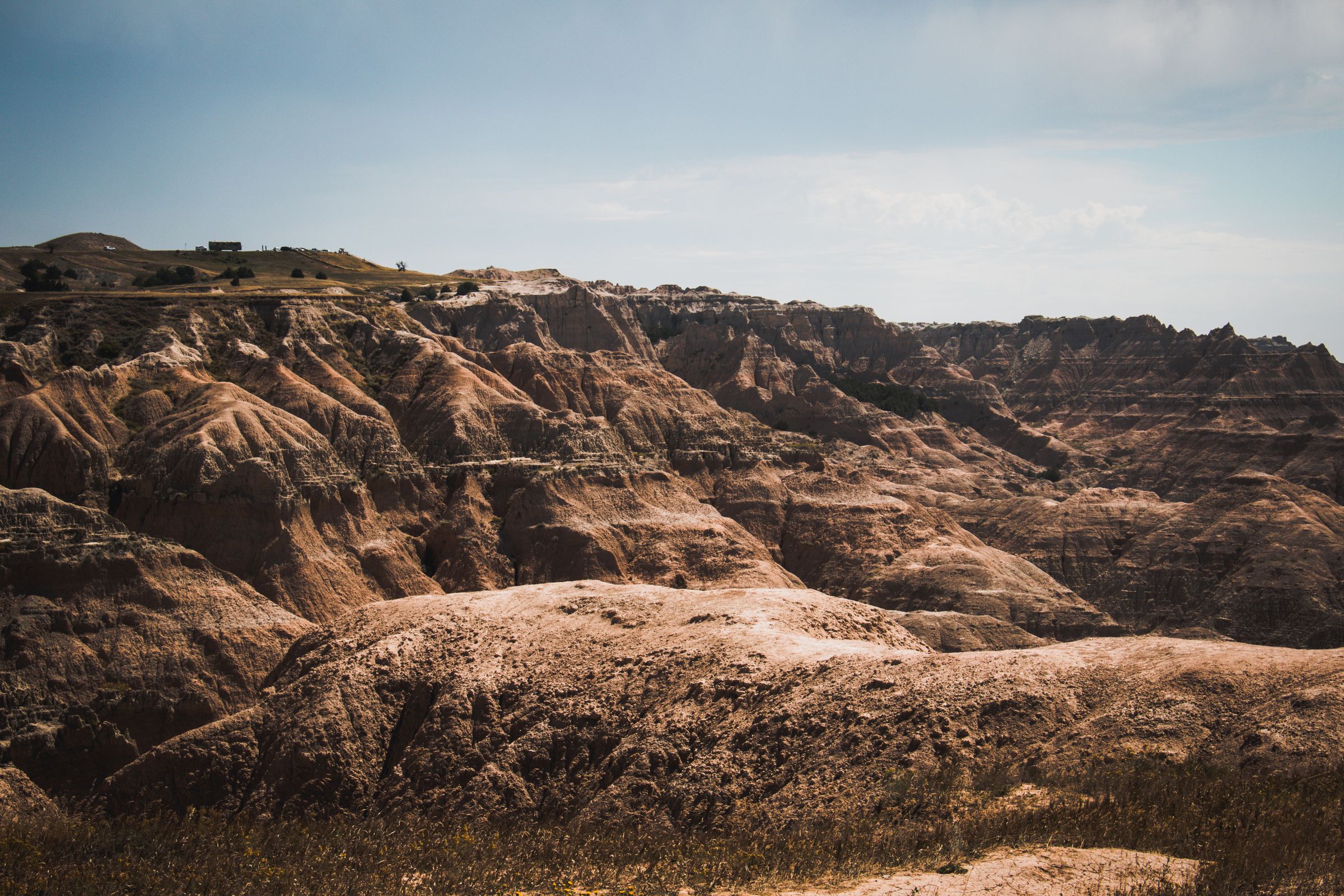
Western US parks do not reward a checklist sprint. Distances look polite on a map. Then you lose an afternoon to a gravel spur, a closed rim road, or a “quick†roadside stop that turns into two hours of free ice water and jackalope photos. Heat in the Badlands hits different from spring snow at Crater Lake. Bighorn Canyon’s north and south districts are not even connected by road.
This hub is the map for trips I’ve already written up from the ground: Badlands camping and Black Hills free days, Wall Drug when you need the kitsch break, Bighorn Canyon (overlooks, pontoon, Medicine Wheel), Montana sapphire dirt and a Glacier-adjacent vortex stop, Grand Teton’s quiet chapels, Oregon’s Crater Lake in spring and John Day’s painted hills, plus the Salton Sea and Bombay Beach when the desert weird calls. Use it to pick a season and a trip shape. Then jump into the linked guides for the day-by-day detail.
At a glance
- Best overall window for most park loops: late May through September (services open; road access widest)
- Shoulder appeal: April-May and September-October (cooler, quieter; more weather and closure risk)
- Signature pieces covered here: Badlands + Black Hills · Bighorn Canyon & Medicine Wheel · Montana detours · Grand Teton chapels · Crater Lake spring · John Day Fossil Beds · Salton Sea / Bombay Beach
- What breaks schedules: seasonal road closures (Crater Lake Rim Drive, Medicine Wheel access), heat, split park districts, “just one more overlookâ€
- Planning rule of thumb: treat optimistic drive time as fiction, ask “is this detour worth the miles?†before you leave the highway, and leave a buffer day every few hard days
- Who thrives: travelers who like parks, public lands, and odd small-town stops more than resort packages
Who this guide is for
- Planners who want season, camping options, and detour judgment before locking a western road trip
- Solo or small-group travelers who care where sleep actually happens after a long Interstate or gravel day
- Anyone stitching Badlands, Bighorn, Oregon geology, or California desert weird into a western story instead of three disconnected tickets
If you want five iconic parks in four days with soft sheets every night, this page will annoy you. If you want the map to feel honest under your tires, stay.
Best time to go
Season is not a vibe out here. It decides whether Rim Drive is open, whether Medicine Mountain is still under snow, and whether the Salton Sea is merely strange or actively punishing.
Late spring into summer (roughly May through August)
Widest access for Bighorn boating, Black Hills drives, Badlands camping with amenities, and most Montana side stops. Crowds rise around holiday weekends. Heat becomes the real itinerary editor in South Dakota and southern California. Leave early. Carry more water than feels polite.
Shoulder (April-May; September-October)
My favorite window for photography and quieter overlooks. Fall color shows up in places like Spearfish Canyon. Spring at Crater Lake still means snow, limited roads, and a different kind of beauty. Medicine Wheel typically opens mid-June and closes by mid-September, so shoulder plans need a hard check on access.
Winter
Possible for some desert and lower-elevation pieces. Not my first pick for a first western parks loop that includes high rim roads or alpine historic sites. Beautiful. Logistically stubborn.
Practical take: one well-timed summer or early-autumn core, with spring Crater Lake or desert heat only if your body and buffer days can absorb the extremes, beats a heroic itinerary that leaves you cooked, snowed out, or arguing with a closed gate.
How to get around
Driving is the point
This hub assumes a car you trust for Interstates, park loops, and the occasional gravel spur. High-clearance helps for backroads near wild-horse viewing and some Bighorn approaches. Tire condition and a spare matter more than a badge with “4WD†on the hatch.
Two districts, one canyon
Bighorn Canyon’s north (Fort Smith, Montana) and south (Lovell, Wyoming) sides do not connect by road through the recreation area. If you want overlooks and wild horses plus a pontoon day from Ok-A-Beh, plan the miles between districts as a real drive, not a dotted line on a brochure.
Seasonal gates and altitude
Crater Lake’s Rim Drive usually stays closed deep into spring. Medicine Wheel sits near 10,000 feet with a 1.5-mile walk from the lot when the road is open. Thin air slows people who underestimate it. I would rather waste a half-day in a small town than arrive after dark arguing with my own itinerary.
Fuel, food, cell service
Stock up before Salton Sea, before Sage Creek vibes in the Badlands, before remote Oregon units. Patchy service is normal between towns. Download offline maps. “There will be a cafe†is not a plan.
Key places & routes (with guides already on the site)
South Dakota: Badlands, Black Hills, Wall Drug
Start east of the Black Hills if you are rolling west on I-90. The Badlands look like someone broke a geology textbook and left the pieces in the sun. Camp if you can. Night skies here are the quiet argument for overnighting instead of day-tripping from Rapid City.
Cedar Pass has flush toilets and the easy visitor-center orbit. Sage Creek is free, rustic, and often shared with bison.
- Badlands National Park camping guide, Cedar Pass vs Sage Creek, backcountry notes, season and heat reality
- Free things to do in the Black Hills, Needles and Iron Mountain drives, Spearfish Canyon, viewpoints that do not require every paid ticket
- What is Wall Drug?, free ice water, 5-cent coffee, how long a stop is actually worth
Wall Drug is kitsch with a Depression-era origin story. Worth 30-90 minutes if you like Americana. Skip the multi-hour shop crawl if daylight is short.
Montana-Wyoming: Bighorn Canyon, pontoon, Medicine Wheel
Underrated relative to Yellowstone noise. Red cliffs. A 71-mile reservoir. Wild horses on the Pryor side. Devil Canyon Overlook is the postcard; the water day is what sticks.
Ok-A-Beh Marina (Fort Smith side) rents pontoons roughly Memorial Day through Labor Day. Half day covers highlights. Full day buys quieter coves and a real swim. Ballpark $250-$600 depending on length and boat size; fuel usually extra.
Medicine Wheel sits high in the Bighorns near Lovell. Sacred site. Fence, prayer cloths, stay on the path. Mid-June through mid-September for most visitors. Not entertainment. Worth the climb if you will treat it that way.
- Bighorn Canyon National Recreation Area guide, north vs south districts, overlooks, hiking, camping, wild horses
- Bighorn Canyon pontoon rental from Ok-A-Beh, half-day vs full-day, costs, what to pack on the water
- Visiting the Bighorn Medicine Wheel in Wyoming, access, altitude, respect guidelines, nearby pairing with the canyon
Montana detours: sapphires and a Glacier-adjacent vortex
Not every western mile needs a park fee station. Near Philipsburg, Gem Mountain lets you wash gravel for Montana sapphires. Buckets run about $55 (2026, verify on the day). Kids love it. Adults pretend they are above treasure hunts, then get competitive.
Outside Columbia Falls, the Montana Vortex and House of Mystery is a tilted-house stop minutes from Glacier’s orbit. Seasonal (about May-September). An hour of optical weirdness after big scenery days.
- Gem Mountain sapphire mine, how the wash stations work, costs, pairing with Philipsburg
- Montana Vortex and House of Mystery, what the tour is like, hours, whether the detour is worth it near Glacier
Grand Teton quiet stops: two chapels
If your loop swings through Jackson Hole, the Chapel of the Transfiguration (Moose) frames the Tetons in the altar window. Chapel of the Sacred Heart sits near Jackson Lake with a quieter forest feel. Summer openings. Active worship spaces. Short stops with human-scale history between trailheads.
- Chapel of the Transfiguration and Chapel of the Sacred Heart, history, how they differ, nearby visitor-center and lake pairings
Oregon: Crater Lake in spring, John Day Fossil Beds
Crater Lake in spring is snow country wearing a national-park badge. South entrance and Rim Village come first. Full Rim Drive and boat tours wait for summer. Solitude and blue-on-white photos: spring works. Loop drive and a boat: wait.
John Day Fossil Beds spreads across three units (Painted Hills, Sheep Rock, Clarno). Free entry. Remoteness is the tax. Painted Hills late light is the money shot. Add Sheep Rock if you want the paleontology story, not only the stripes.
- Crater Lake in the spring, road reality, snow sports, what stays closed, packing for winter-in-May
- John Day Fossil Beds National Monument, which unit to prioritize, trails, season, drive times from Bend or Portland
California desert weird: Salton Sea and Bombay Beach
About 150 miles southeast of Los Angeles, the Salton Sea is the opposite of a brochure beach. High salinity. Abandoned resort dreams. Art, bird refuges, Salvation Mountain and Slab City in the same desert orbit. Cooler months (roughly November-March) are saner. Summer can top 110°F.
Bombay Beach is the ghost-town-plus-art chapter. Shoreline decay, murals, a living community that does not exist for your photoshoot. Bring water. Respect occupied places that look abandoned.
- Salton Sea things to do, state rec area, wildlife refuge, Salvation Mountain, day-trip shape from Palm Springs
- Visiting Bombay Beach, history, art scene, photography etiquette, practical limits
Sample ways to stitch a trip
These are shapes, not sacred itineraries. Borrow the structure, then change it to suit your pace and what is open when you go.
A. South Dakota parks weekend · about 3-5 days Wall → Badlands camping (Cedar Pass or Sage Creek) → Black Hills free days → optional Wall Drug on the way in or out. Do not try to “do Rushmore and everything else†in one breathless afternoon.
B. Bighorn deep dive · 3-4 days Lovell side for the scenic byway and Medicine Wheel if open → transfer to Fort Smith for a pontoon day from Ok-A-Beh. Read the Bighorn Canyon guide before you pretend the districts are next door.
C. Montana quirky add-ons · 1-2 days bolted onto Glacier or a Philipsburg swing Gem Mountain with a Philipsburg main-street pause, or the Montana Vortex as a Glacier exit diversion. Neither replaces a park day. Both make a road trip feel like yours.
D. Oregon geology loop · 2-4 days Crater Lake in spring if you accept snow limits, or wait for full summer access → east to John Day Fossil Beds (Painted Hills + Sheep Rock is the usual pair). Clarno if you have appetite for remoteness.
E. Southern California desert day · 1 long day from Palm Springs / LA / San Diego Salton Sea highlights with a focused Bombay Beach wander. Cooler months only unless you enjoy baking.
F. Tetons pause · a few hours inside a larger Wyoming loop Both chapels between Moose and Jackson Lake when you want quiet between trailheads.
Mix freely. The point of a hub is options with judgment.
Packing & logistics
Full packing notes live inside the camping, Crater Lake, and pontoon posts. Mindset for this hub:
- Layers for high-elevation mornings and desert afternoons (the temperature swing is the whole joke)
- More water than the optimistic version of you packed last trip
- Sun kit: hat, SPF, sunglasses (snow glare at Crater Lake counts)
- Offline maps plus a paper backup for remote Oregon and canyon districts
- Sturdy shoes for gravel walks (Medicine Wheel) and uneven Badlands trails
- Wind-worthy tent on the prairie; stove fuel if fires are banned
- Cooler and picnic gear for pontoon days and John Day unit-hopping
- Permission to book a real room after a brutal heat or gravel stretch (one comfort note: if you run hot when a vehicle turns into a greenhouse, or you are traveling at midlife and sleep is non-negotiable, plan easy on/off layers and do not stack your hardest days back to back)
- Know which stops are free before you budget park fees
Fuel when you can. Shade when you can. Heat stroke does not care that your itinerary looked tidy in a spreadsheet.
FAQ
How many days do I need for a western US parks starter trip?
A focused South Dakota block needs roughly 3-5 days. Bighorn with a boat day wants 3-4. Oregon geology is a separate 2-4. Trying to stitch Badlands, Bighorn, Crater Lake, and Salton Sea into one week is how people remember gas stations, not places.
Is Wall Drug worth leaving the highway for?
Yes for 30-90 minutes if you like roadside Americana and need a stretch near the Badlands. No if you only have a tight window before sunset at an overlook. Details: What is Wall Drug?.
Cedar Pass or Sage Creek for Badlands camping?
Cedar Pass if you want toilets, water, and easy visitor-center access. Sage Creek if you want free, rustic, and a better shot at bison wandering the neighborhood. Guide: Badlands camping.
Can I see both sides of Bighorn Canyon in one day?
Technically you can drive between districts. Practically you will rush the best parts. Split days, or pick overlooks/horses on one side and water time on the other. Start with Bighorn Canyon and the pontoon post.
Is Crater Lake worth it in spring?
Yes if you want snow, solitude, and rim views without full road access. No if your non-negotiable is Rim Drive or a boat tour. Read Crater Lake in the spring before you book lodging around a fantasy itinerary.
Is the Medicine Wheel respectful to visit as a tourist?
Yes if you stay on the path, leave offerings and stones alone, keep noise down, and treat it as a living sacred site rather than a photo booth. Access notes: Bighorn Medicine Wheel.
Is the Salton Sea safe / can you swim?
Safe to visit with normal desert caution. Swimming is a bad idea (salinity and water quality). Go for landscape, art, and birds. Guides: Salton Sea and Bombay Beach.
Solo traveler: is this reckless?
Not if you plan for the tired version of yourself at 9 p.m., not only the brave version at breakfast. Fuel early, download maps, tell someone your check-in rhythm on remote legs, and skip stacking desert heat with alpine altitude on back-to-back days.
Next step
Pick a season and a trip shape. Open the matching spoke, whether that is Badlands camping, Bighorn Canyon, Crater Lake in spring, John Day, or the Salton Sea, and build from there. I’ll keep adding routes as I cover more ground; for now, these are the parks and detours already written up from the road.
Related guide hubs
These companion guides help turn a parks itinerary into a complete, practical trip.
- Northern and Arctic overland travel guide
- Ethiopia and Horn of Africa travel guide
- Flashpacker travel logistics guide
For a Europe overland stitch with ferries and trains, see my Balkans and Adriatic overland travel hub.
For an Indonesia ferry and bus stitch (Bali, Padangbai, Nusa Penida, Flores), see my Indonesia islands overland travel hub.
